Glossary Of Oral And Maxillofacial Implants
 Dental Management of the Pregnant Patient
 Dental Benefits and Practice Management
 Clinical Management of Temporomandibular Disorders and Occlusion, 9th Edition
 Dentistry and the Pregnant Patient
 Implant Site Development
 MCQs, SAQs, EMQs and OSCEs for Oral Pathology and Oral Medicine: An Exam-Focused Approach
 Quintessence of Dental Technology, Archive 2000 to 2020 (QDT)
 Digital Guided Micro Prosthodontics
 Medical Emergencies Guide For Dental Auxiliaries, 5th Edition
 Change Your Smile, 3rd Edition
 Clinical Cases in Orofacial Pain
 Concise Prosthodontics, 2nd Edition (Original Copy)
 Comprehensive Occlusal Concepts in Clinical Practice
 Fradeani Masterclass: Esthetic Rehabilitation with Ceramic Veneers
 MCQs for Oral Radiology: Principles and Interpretation
 Fixed Prosthetic Restorations: Common Mistakes and Advanced Solutions
 MCQs for Netter’s Head and Neck Anatomy for Dentistry
 Comprehensive Cleft Care, 2nd Edition (Volume I + II)
 Orofacial Disorders: Current Therapies in Orofacial Pain and Oral Medicine
 Bone Biology Harvesting Grafting For Dental Implants
 Soft Tissue Management: The Restorative Perspective, Putting Concepts into Practice
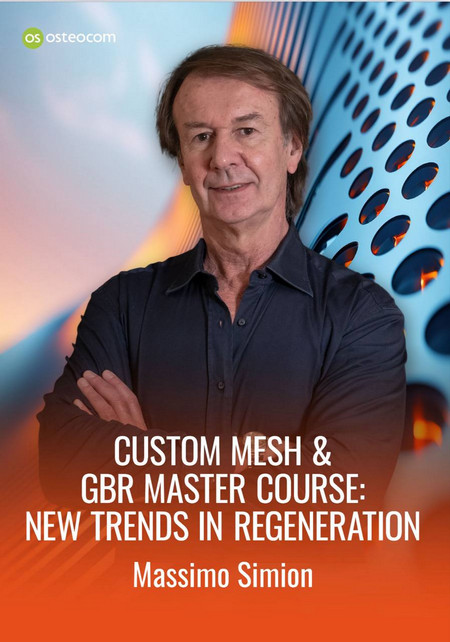
Description
Bone regeneration of severe vertical and horizontal defects and soft tissue management
Thanks to this comprehensive, clinically oriented, and evidence-based training program, you will deepen your understanding of maintaining bone volume, correcting complex horizontal and vertical defects, managing peri- implantitis, and achieving predictable aesthetic and functional outcomes.
Through in-depth analysis of clinical indications, biomaterial selection criteria, and surgical timing, Prof. Massimo Simion explores horizontal and vertical regeneration strategies using both resorbable and non-resorbable membranes—including reinforced e-PTFE membranes—and custom-made titanium meshes.
Special focus is given to the integration of digital technologies, from CBCT evaluation to the pre-surgical design of regenerative devices, and to the surgical management of both posterior and anterior sites, including highly esthetic areas.
Join Prof. Massimo Simion to master the differentiated treatment of dehiscences, fenestrations, and bone resorptions, ensuring optimal and predictable outcomes!
Topics covered in the course:
- Custom meshes: advantages and clinical indications
- Vertical ridge augmentation with custom titanium meshes
- Flap design, placement, and fixation of titanium grids
- Regenerative techniques using resorbable and non-resorbable membranes
- Clinical indications and limitations of different membrane types
- Surgical techniques for managing horizontal and vertical bone defects
- GBR approaches using only connective tissue
At the end of the course, you’ll be able to:
- Understand the biological and clinical criteria behind membrane selection
- Determine when and how to use resorbable membranes, non-resorbable membranes, and custom titanium meshes
- Apply surgical protocols for horizontal and vertical bone augmentation in cases of partial edentulism in the maxilla and mandible
- Evaluate the benefits of the new semi-permeable titanium meshes compared to traditional e-PTFE membranes
- Differentiate the therapeutic approach based on the type of defect to be treated (dehiscences, fenestrations, recessions) and the amount of residual bone
- Use digital workflows to plan GBR procedures
- Integrate soft tissue management into regenerative treatment planning
Presented By:
9 Videos - Duration: 6 hours & 11 min - Files size: 22.9 GB